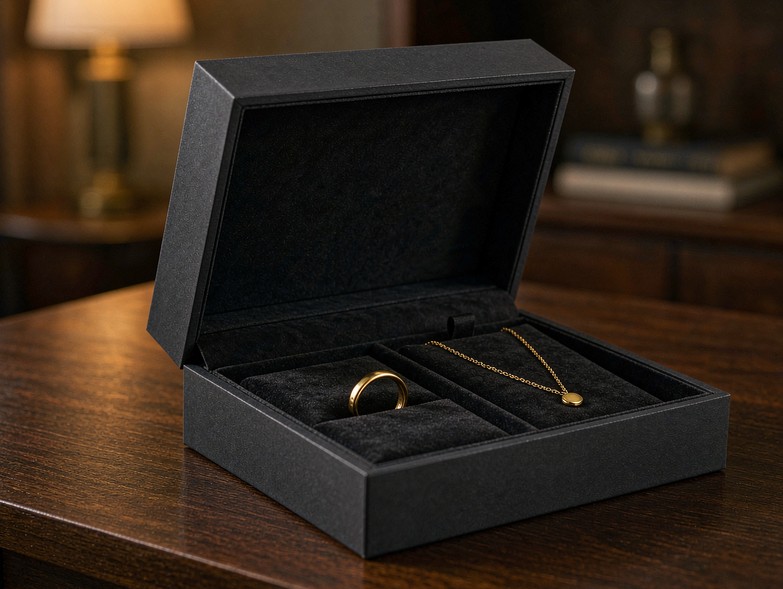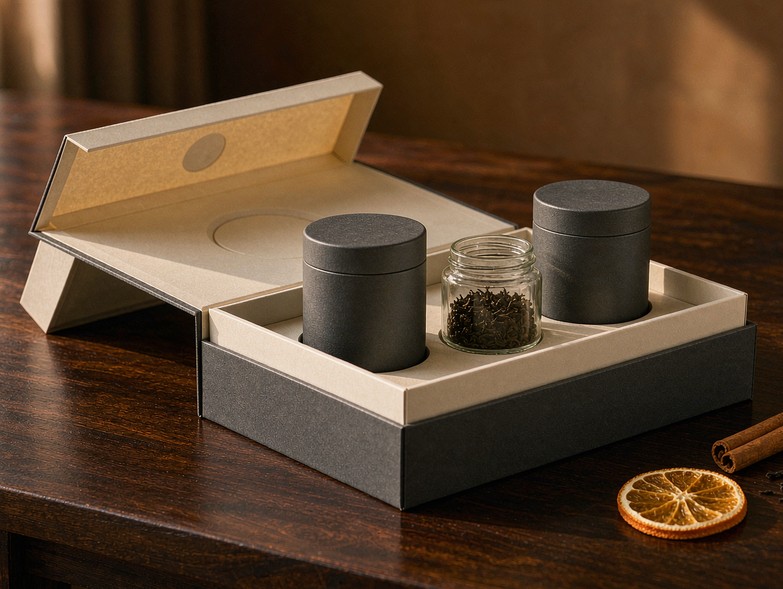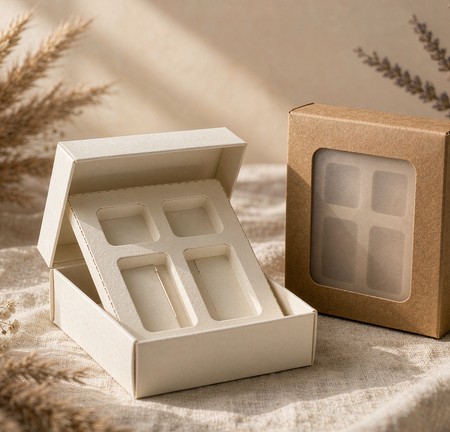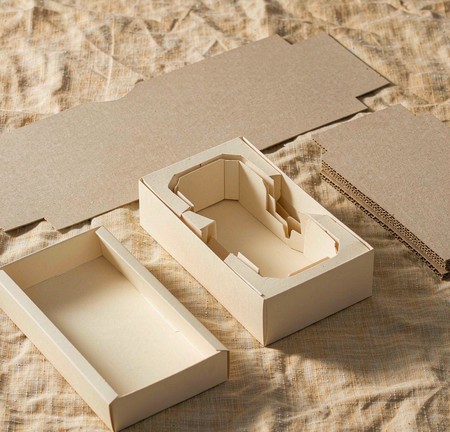
A rigid gift box MOQ and tooling cost guide explains one thing: why the same box costs different amounts at different order sizes. MOQ is not a gate a factory invents to turn away small buyers. It is the point where one-time setup charges stop dominating the unit price. The practical answer is to ask for tooling and unit price on separate lines, then compare the total cost per delivered box at your real quantity. This guide works through one sourcing case with three quotes, so every cost line has a reason and a decision attached to it.
Contents
- The case: three quotes for three ceramic gift boxes
- What MOQ actually measures
- The rigid gift box MOQ and tooling cost guide, line by line
- Why a small trial costs more per unit, and how to run one anyway
- Compare 100, 500 and 1,000 units on total cost
- Multi-SKU: one dieline, several artworks
- What a quote cannot fix, and who owns each part
- Conclusion: the quote format that makes suppliers comparable
The case: three quotes for three ceramic gift boxes
A home fragrance brand is launching three ceramic diffuser gift boxes. All three share one box size and one structure, but each has its own artwork and scent label. The first order is a 100-set trial for a seasonal launch, with a forecast of 1,000 sets if the trial sells. This is a composite of common sourcing situations, not a named customer or a reported result.
Three quotes come back:
- Quote A gives one number, USD 2.10 per box, with no separate line for the cutting die or the foil plate.
- Quote B gives USD 1.45 per box plus USD 1,800 in one-time charges, but applies a 500-piece MOQ to each artwork version, so three versions mean 1,500 boxes before production starts.
- Quote C separates tooling from unit price, proposes one shared dieline with a variable belly band for each scent, and quotes one MOQ across all three versions.
Quote A looks cheapest and is the hardest to check. Quote C is the only one that makes the trial possible without buying 1,500 boxes. The difference is not the factory, it is the format of the quote. For the product range behind this case, see our cultural and creative products and home furnishings packaging overview.
What MOQ actually measures
MOQ is the quantity at which setup work becomes a small part of the unit cost. A rigid box line has to cut a die, make plates, set up the wrapping and assembly steps, and accept a certain amount of start-up waste. Those costs do not change much whether you run 100 boxes or 1,000, so the factory needs a volume over which to spread them.
That is why MOQ should always be stated per variant, not per project. A box with three artworks is three production variants if each one needs its own plates or its own setup. Ask the supplier to write the MOQ next to each variant, and to say which parts are shared. The custom gift box RFQ checklist has a field for quantity tiers per version, so this question gets answered before any quote arrives.
A supplier who quotes a low MOQ without explaining which setup steps are shared is not necessarily wrong, but the number is not comparable. Two rules help here. First, MOQ is a cost structure, not a judgment on your order size. Second, a small first order is a normal way to start, as long as the quote shows what it costs and what can be reused later.
The rigid gift box MOQ and tooling cost guide, line by line
One-time charges are the part of a quote that buyers most often compare badly. The table lists the charges that belong on their own line, what each one pays for, and whether it comes back on a repeat order.
| One-time charge | What it pays for | Back on a repeat order? | What changes the amount |
|---|---|---|---|
| Cutting die | The steel rule that cuts the greyboard and wrap to shape | No, if the size and structure are unchanged | Box size, number of parts, V-grooves |
| Printing plates | Plates for offset printing of the artwork | Only if the artwork changes | Number of colors, spot colors |
| Foil or embossing die | The metal die that stamps a logo or pattern | Only if that logo or pattern changes | Die area, detail level, number of versions |
| Insert mould | Tooling for a moulded pulp or formed insert | No, if the cavity is unchanged | Cavity shape, number of cavities |
| Assembly jig | A fixture that holds the box during wrapping and gluing | No, if the structure is unchanged | Structure complexity |
| Sample development | A physical pre-production sample with your artwork | Ask whether it is credited against production | Number of sample rounds |
The point of separating these lines is not accounting neatness. It lets you see which costs disappear on a reorder, which come back every time you change artwork, and which supplier has quietly folded them into the unit price. A structure choice also changes the list: a two-piece rigid box uses fewer parts than a magnetic or drawer style, so it usually has a shorter setup list.
When structure is still open, the magnetic closure vs drawer box sourcing guide compares both on cost, MOQ and lead time.
3.1 The charges fragile cultural products add
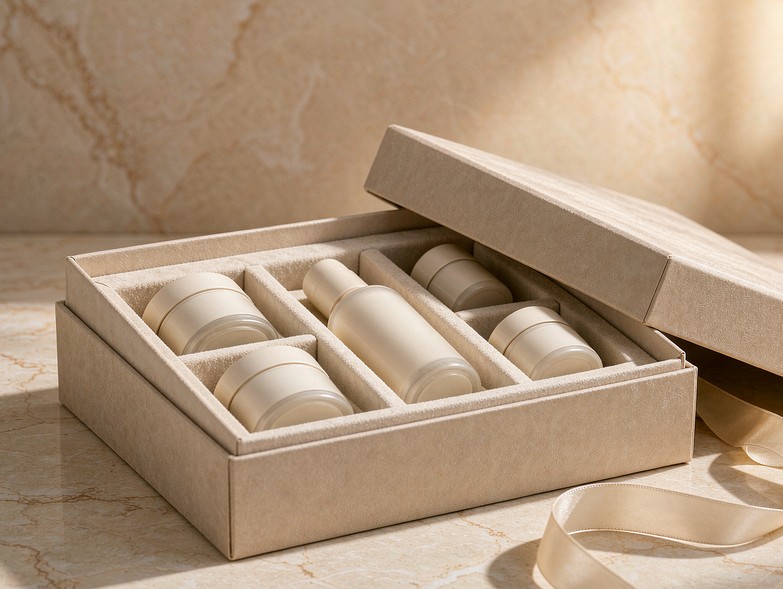
A glazed ceramic or glass item adds four lines that a standard cosmetic box does not need. A moulded insert needs its own cavity tooling. Corner protectors add a part and a labour step. An E-flute outer shipper adds a second structure to the order. And a drop test adds a check with a pass or fail record, not just a visual inspection.
These are real costs, and they are worth paying for on a breakable product, but they should be visible. Recognized test procedures are published by ISTA, and a formal report is issued by an independent laboratory when a buyer needs one.
Insert choice also has its own tooling and MOQ logic, which the molded pulp vs foam inserts cost comparison breaks down.
3.2 Which charges return when you reorder
Ask one direct question before you place the first order: if I reorder the same box in six months, what do I pay again? The answer should be short. Material, labour and freight return. Tooling does not, unless the size, structure or artwork changes. A foil die is the common exception, because a new logo means a new die even on the same box.
This is also where a cheap first quote can cost more over a year. If a supplier folds tooling into the unit price, you pay a share of it on every reorder instead of once. Over three or four orders, the “cheaper” quote is often the more expensive one.
Why a small trial costs more per unit, and how to run one anyway
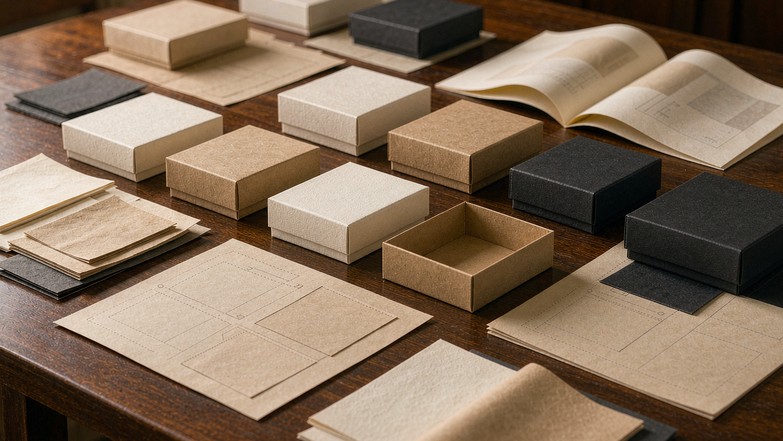
A 100-box trial carries a high cost per unit because the setup is divided by 100. This is arithmetic, not a refusal. The total cash you commit is still lower than a 1,000-box order, and that matters more to a launch budget than the per-unit figure.
The practical question is how to make the trial cheaper without losing the test. Five options work, and several can be combined:
- Use an existing dieline in a standard size instead of cutting a new one.
- Use a stock or simple paper insert for the trial, then move to a fitted insert at volume.
- Approve a digital proof or a plain white sample before cutting any printing plate.
- Put the variable information on a label or belly band, so one printed wrap serves several versions.
- Combine the trial quantities of all SKUs into one production run.
None of these turns the trial away. Each one removes a setup step that the trial does not need yet. In our case, Quote C becomes workable because options 4 and 5 remove two plate sets and collapse three MOQs into one. A supplier who offers these choices is giving you a cheaper first order, not a smaller one.
Our own sampling takes 3 days, with mass production at 10 to 15 days from confirmed artwork and sample sign-off. That clock starts at approval, not at deposit, so a trial with fewer setup steps also reaches the shelf sooner. We have made rigid and folding gift boxes for 25 years, and the most common first-order mistake we see is paying for full production tooling before the structure has been tested with the real product inside.
Compare 100, 500 and 1,000 units on total cost
The table applies the cost structure to our case. All figures are hypothetical arithmetic for illustration only, not a price quote and not our prices. Replace every line with the numbers from your own supplier.
| Quantity | Unit price | Tooling total | Tooling per unit | Freight per unit | Total per delivered box |
|---|---|---|---|---|---|
| 100 | 3.20 | 900 | 9.00 | 0.80 | 13.00 |
| 500 | 2.10 | 900 | 1.80 | 0.70 | 4.60 |
| 1,000 | 1.75 | 900 | 0.90 | 0.65 | 3.30 |
Three conclusions follow. The unit price falls slowly, while the tooling share falls fast. The 100-box run has the highest cost per box but the lowest total spend, which is why a trial still makes commercial sense. And the comparison only works when tooling is a separate line, otherwise Quote A and Quote C cannot be compared at all.
Add one more line before you decide: dimensional weight. Rigid boxes ship mostly air. A box that is 20 percent larger can cost more in freight than it saves in board, because carriers charge by volume as well as weight. Ask for the carton dimensions and the number of boxes per carton at quote stage, then compare freight per delivered box, not freight per order. Choosing a flat-pack or collapsible structure can lower that line on long-distance orders, and the trade-off belongs in the same table as the tooling.

Multi-SKU: one dieline, several artworks
Each artwork version can create its own MOQ, its own plates and its own inventory risk. A shared dieline breaks that link. The outer box, the insert cavity and the cutting die stay the same, while the version information moves to a label, a belly band or a small printed sleeve. Barcodes and version codes need to stay correct on those variable parts, so follow GS1 barcode standards when you design them.
| Approach | Tooling | MOQ effect | Best fit |
|---|---|---|---|
| Separate dieline and artwork per SKU | Full set for each version | Each version carries its own MOQ | Products with genuinely different sizes |
| One dieline, separate printed wraps | One die, several plate sets | One shared box MOQ, plate cost per version | Seasonal artwork with stable structure |
| One dieline plus variable label or belly band | One die, one wrap | One MOQ across all versions | Trial runs and scent or color variants |
The third row is usually right for a first launch of cultural or home products, because the differences between versions are often only artwork and wording. It also makes the reorder simpler: you repeat one wrap and reprint a small label, instead of setting up three full print runs. For our case, this is the change that turns 1,500 boxes of commitment into 100.
What a quote cannot fix, and who owns each part
Some numbers in a quote are estimates by nature. Naming them early prevents a dispute later, and it is one of the clearest signs of a supplier who has run export orders before. Four items belong here.
- Freight is an estimate until the goods are packed. Carton size, final weight and freight rates can all move. Our practice is to list freight as its own line and recalculate it against the actual carton data before shipment, then confirm with the buyer.
- Material prices, exchange rates and duties sit outside the box specification. We state a quote validity period and keep those items visible, so a change is a discussion rather than a surprise.
- We run in-house drop, moisture and transit checks and keep the records. We do not issue third-party certificates ourselves. When a buyer needs a formal report, we prepare the samples and the test specification, and an independent laboratory issues it. That is a division of signing authority, not a gap in testing.
- We build to the specification you name. We do not sign off legal compliance for your market, but we share the document list we usually see for that market and supply FSC chain-of-custody papers where required. Final confirmation stays with your brand or your local adviser.
None of this changes whether your order is 100 boxes or 10,000. The same itemized structure applies to both. Our quality system is ISO 9001 with a defect rate below 0.5%, and the approval gates are the same on every run: a digital proof, a physical pre-production sample, a check with your real product inside, and a golden sample both sides keep. The full sign-off sequence is set out in the packaging supplier sampling and approval process.
Conclusion: the quote format that makes suppliers comparable
A rigid gift box MOQ and tooling cost guide is useful only if it changes what you ask for. In our case, the decisive move was not finding a cheaper factory. It was asking three suppliers to show tooling and unit price on separate lines, state MOQ per variant, and price a shared dieline with a variable belly band.
Take four steps into your next quote. Send the same written specification to every supplier. Ask for one-time charges as separate lines with their repeat-order behavior. Compare total cost per delivered box at your real quantity, including dimensional weight. Then ask which setup steps a small trial can avoid. A supplier who answers all four is easier to compare, and easier to reorder from.
Send your box dimensions, quantity tiers and number of artwork versions through our cultural and creative products and home furnishings packaging page. We will return a quote with tooling and unit price listed separately, show the tooling share at each quantity tier, and produce a physical sample in 3 days.
What does MOQ mean for a rigid gift box?
MOQ is the volume at which one-time setup costs stop dominating the unit price. It covers work such as cutting dies, printing plates and machine setup, not a judgment on your order size. Ask for MOQ per artwork version, because three versions can mean three separate minimums unless the dieline is shared.
Why is a 100-unit order more expensive per box?
The same tooling total is divided by 100 instead of 1,000, so the tooling share per box is much larger. The total cash commitment is still lower, which is why a trial often makes sense. Reduce the per-unit figure by sharing a dieline, using a stock insert, or putting version details on a label.
Are tooling charges paid again on a repeat order?
Usually not. Material, labour and freight return on every order, while a cutting die or insert mould does not, as long as size and structure stay the same. Foil and embossing dies are the exception: a new logo means a new die. Ask the supplier to state this in writing before the first order.
How can several SKUs share one MOQ?
Keep one box size, one dieline and one insert cavity, then move the differences to a variable label, belly band or sleeve. The outer wrap stays common, so the production run is a single variant. Follow GS1 barcode standards so each version still scans correctly.
Is the sample fee credited against production?
Policies differ, so ask before you approve a sample and get the answer in writing. What matters as much is the approval gate: a physical pre-production sample with your real product inside should be signed off before tooling and plates are committed. Our sampling takes 3 days from confirmed artwork.
What should an itemized quote list separately?
It should list the unit price, each one-time charge, the MOQ per variant, the repeat-order behavior of tooling, packing and freight, the trade term, and the quote validity period. With those lines present, two suppliers can be compared on total cost per delivered box. Without them, a low unit price may simply hide a setup charge.