Submitting a vague request like “I need 1,000 luxury jewelry boxes” guarantees an inaccurate, delayed response that jeopardizes your procurement timeline. To get an accurate custom jewelry box quote, you must provide the specific jewelry type, precise product dimensions, exact quantity splits per SKU, desired box structure, internal insert requirements, and target delivery dates. However, you do not need a finalized digital design to start the process; providing basic product details and reference images allows a professional manufacturer to reverse-engineer the perfect packaging solution and provide actionable pricing.

Table of Contents
- The Core Framework of a Custom Jewelry Box RFQ
- Why Product Type and Dimensions Drive Structural Pricing
- How Quantity Splits and MOQ Impact the Final Quotation
- Navigating Box Structures, Materials, and Custom Inserts
- Submitting Logos, Branding, and Visual Reference Images
- RFQ Strategies for Startups, E-Commerce, and Replenishment
- Accelerating Your Jewelry Packaging Quotation Without Full Designs
1. The Core Framework of a Custom Jewelry Box RFQ
In B2B packaging procurement, speed and accuracy are everything. A manufacturer cannot generate a reliable custom jewelry packaging quote based on assumptions.
The information needed for a custom jewelry box quote forms a structural blueprint; missing details—such as specific dimensions, material preferences, or quantity—force the supplier to provide rough estimates rather than actionable, production-ready pricing.
A professional manufacturer needs to understand the physical demands of your product before recommending a packaging architecture. The goal of an RFQ (Request for Quotation) is not just to discover the unit price, but to establish a feasible supply chain timeline. By providing a structured overview of your project, you eliminate the back-and-forth communication that delays product launches.
Custom Jewelry Box Quotation Checklist
| Information Category | Specific Data Required | Why It Matters for Pricing |
| Product Type | Ring, necklace, bracelet, earrings, or set. | Dictates the overall box geometry and the complexity of the internal protective insert. |
| Dimensions | Product size (L×W×H) or target box size. | Determines raw material consumption and shipping volume (dimensional weight). |
| Quantity (Split) | Total volume broken down by specific SKUs. | Directly impacts the amortization of fixed tooling and printing plate setup costs. |
| Structure & Material | Rigid box, drawer, magnetic closure; paper vs PU leather. | Defines manufacturing labor time and base raw material expenditures. |
| Insert Requirements | EVA foam, velvet, molded pulp, or die-cut paper. | Adds specific material costs and requires custom structural die-cutting. |
| Branding & Finish | Foil stamping, embossing, UV coating; logo size. | Dictates the number of machine passes required after the initial printing phase. |
| Logistics | Target delivery date and destination country. | Validates if the project timeline is feasible and helps estimate final landed costs. |
2. Why Product Type and Dimensions Drive Structural Pricing
The foundation of any jewelry box pricing request is the physical footprint of the item it must contain.
Providing precise product dimensions allows the manufacturer to calculate the exact amount of raw material required, while specifying the jewelry type dictates the necessary depth and complexity of the internal cavity.
If you simply request a “jewelry box quote,” the manufacturer must guess the size. A box designed for a delicate pair of stud earrings requires drastically less rigid paperboard than a box designed for a heavy, multi-layered pearl necklace.
When preparing your RFQ, provide the Length × Width × Height (or Thickness) of the actual jewelry piece. If you already know the exact exterior dimensions you want the box to be, state that clearly: “Target Box Size: 100mm × 100mm × 50mm.” If you are unsure of the optimal box size, simply provide the product dimensions alongside physical photos. An experienced manufacturer of jewelry and luxury goods packaging will use this data to engineer the most space-efficient box structure for you.
3. How Quantity Splits and MOQ Impact the Final Quotation
Order volume is the single most influential factor in B2B packaging economics. However, providing a single lump-sum number is often insufficient.
When requesting a jewelry packaging quotation, you must break down your total order quantity by specific SKUs, because different box sizes or insert variations require entirely separate tooling setups that alter the unit price.
Do not just write “3,000 pieces.” If your project encompasses multiple items, format your RFQ to reflect the split:
- 1,000 pcs for rings (requires ring slot insert)
- 1,500 pcs for necklaces (requires larger box and custom velvet insert)
- 500 pcs for bracelets (requires specialized pillow insert)
Because each of these variations requires a different physical cutting die and potentially a different printing plate, the factory must calculate the setup costs independently. Furthermore, if you are a new brand testing a market, state your preferred Minimum Order Quantity (MOQ). A flexible supplier will provide tiered pricing (e.g., pricing for 500, 1,000, and 5,000 units), allowing you to make an informed financial decision based on your inventory strategy.
4. Navigating Box Structures, Materials, and Custom Inserts
You do not need to be a packaging engineer to request a quote, but providing directional guidance on aesthetics and functionality is crucial.
If you are unsure of the exact custom jewelry box specifications, providing product photos allows the manufacturer to recommend the optimal rigid structure, premium material covering, and protective custom insert for your brand.
Defining the Structure and Material
If you already know what you want, state it: “I need a two-piece rigid box wrapped in black matte specialty paper.” However, if you are unsure, do not let that stall your RFQ. You can simply state: “I prefer a premium black finish, but I’m open to material recommendations.” The factory will evaluate your product value and suggest whether standard coated paper, textured paper, or PU leather fits best.
The Importance of the Insert
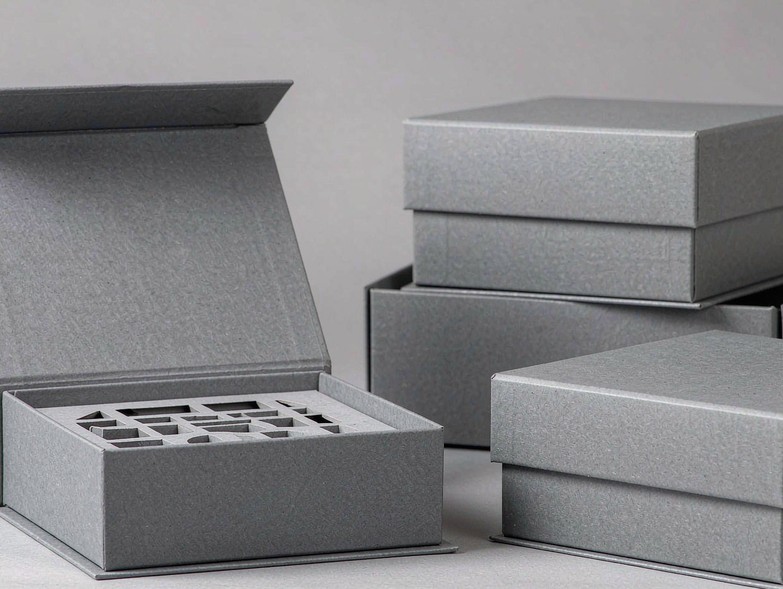
The interior architecture is often more complex than the exterior. You must communicate how the jewelry should be held. Does the necklace need to be pinned down? Does the ring need to stand upright? High-end jewelry and luxury goods packaging relies heavily on custom inserts made of EVA foam, velvet, or microfiber. If you do not know which material is best, simply provide the jewelry photos and let the supplier engineer the protective layout.
5. Submitting Logos, Branding, and Visual Reference Images
A common misconception is that you must have a finalized Adobe Illustrator file ready before you can ask a factory for a price.
You can initiate a custom jewelry box RFQ without finalized digital artwork by providing reference images of competitor packaging, a basic logo file, and your preferred surface finishes to allow the factory to estimate production costs.
Visual communication is faster and more accurate than text. If you want a specific style of magnetic closure or a unique opening experience, attach a Pinterest board, a photo of a competitor’s box, or a snapshot of an existing sample. Tell the supplier: “We want something similar to this box.”
For branding, outline your desired finish. Do you want gold foil stamping, deep debossing, or a minimalist printed logo? The complexity of these finishes dictates how many times the box must pass through specialized machinery, directly impacting the final quote. The final vector artwork can be refined later during the formal sampling phase.
6. RFQ Strategies for Startups, E-Commerce, and Replenishment
Different business models require different types of data to generate a commercially useful quotation.
Tailor your information to send for a jewelry box quote based on your business model; e-commerce brands must highlight shipping destinations to calculate logistics, while existing brands should provide photos of current packaging for rapid optimization.
- New Jewelry Brands: If you do not have complete specifications, send what you have (product photos, estimated dimensions, target launch date, and reference images). Allow the factory to act as a consultant to build your packaging strategy from the ground up.
- Existing Brands (Replenishing or Switching Suppliers): If you already have packaging, do not reinvent the wheel. Send photos of the existing box, precise dimensions, current material specs, and detail exactly what needs to be improved (e.g., “The current insert is too loose”).
- E-Commerce Brands: The physical weight and dimensional volume of the box directly impact your outbound shipping margins. When requesting a quote, include your shipping destination and ask the supplier to optimize the box size for courier networks, ensuring you don’t overpay for shipping empty space.
7. Accelerating Your Jewelry Packaging Quotation Without Full Designs
The most significant barrier to B2B procurement is the false assumption that an RFQ requires 100% finalized engineering files.
Do not delay your procurement timeline waiting for perfect designs; submit your core product data today, allow the manufacturer to recommend the optimal custom packaging structure, and finalize the exact details during the physical sampling phase.
A professional manufacturer of jewelry and luxury goods packaging expects to collaborate on the final design. Your initial RFQ is the starting point. Once the supplier provides a baseline quotation based on your product dimensions and reference images, you move into the critical sampling phase.
By utilizing rapid prototyping (often yielding a physical sample in just 3 days), you can physically verify the color, texture, structural rigidity, and insert fit. This staged approach—Quote → Sample → Approval → Bulk Production—dramatically lowers your procurement risk and ensures the final mass-produced box perfectly aligns with your brand’s vision.
Conclusion
Securing an accurate custom jewelry box quote does not require a degree in packaging engineering, but it does require structured communication. By providing the specific jewelry type, precise product dimensions, detailed quantity splits, and clear visual references, you empower the manufacturer to deliver actionable pricing rather than vague estimates. Remember, you do not need finalized vector artwork to start the conversation. By submitting the core data you have today, you can leverage the supplier’s expertise to recommend the ideal materials, engineer custom inserts, and initiate rapid physical sampling, keeping your product launch flawlessly on schedule.
Not sure which box structure or insert you need?
Do not let incomplete designs delay your packaging project. Send us your product details, quantity requirements, and reference images, and our engineering team will provide expert recommendations and a detailed custom jewelry packaging quote tailored to your brand.
Frequently Asked Questions (FAQ)
1. Can I get a quote if I don’t know the exact dimensions of the jewelry box?
Yes. You do not need to know the final box size. Simply provide the exact dimensions (Length × Width × Height) of the jewelry itself, along with a photograph. The packaging manufacturer will calculate the necessary clearance and recommend the most efficient box dimensions for you.
2. Why do I need to break down my order quantity by jewelry type?
Different jewelry types (e.g., rings vs. necklaces) require different box sizes and entirely different internal custom inserts. Because each variation requires a unique physical cutting die and machine setup, the factory must quote each SKU separately to provide accurate pricing.
3. Do I need a finalized logo design to request a packaging quote?
No. While finalized vector artwork is required for mass production, you can initiate a quote by simply stating your preferred finishing method (e.g., “I want a gold foil-stamped logo on the lid”). You can refine and submit the final digital artwork during the sampling phase.
4. What is the best way to explain the box style I want if I don’t know the technical terms?
The most effective method is visual communication. Attach reference images, photos of competitor packaging, or a Pinterest board to your RFQ. This immediately clarifies your expectations regarding the box structure, opening mechanism, and overall aesthetic without needing technical jargon.
5. Will the factory help me choose between velvet, EVA foam, or paper inserts?
Yes. If you are unsure which internal material is best for your specific jewelry piece, simply explain your budget and brand positioning in your RFQ. An experienced manufacturer will recommend the insert material that provides the best balance of product protection and luxury presentation.
6. Why is providing a target delivery date important in the initial RFQ?
Providing a target date allows the manufacturer to immediately assess whether your timeline is feasible based on their current factory capacity. It also dictates whether the finished goods must be shipped via fast (but expensive) air freight or economical sea freight, which drastically impacts your total landed cost.