Opening a shipping container only to be hit by a musty odor is a procurement manager’s nightmare. Moldy arrivals mean rejected pallets, failed retail quality control, and — in our experience — a single mold-affected shipment can write off an entire container’s worth of retail value, which is why buyers treat moisture control as an engineering problem rather than a packaging afterthought. While brand owners often blame the garment factory for “wet clothes,” the root cause usually lies in how the packaging interacts with the extreme climate of ocean transit.
This guide explains the science behind sea freight moisture damage and provides a factory-ready brief on how to prevent mold in sea freight clothing — desiccant dosing, barrier specs, and QC checks you can send straight to your packaging supplier. By engineering moisture prevention directly into the box, you can eliminate this expensive supply chain risk. For a broader view of how packaging protects your product, review our master Apparel Packaging Guide.
Table of Contents
- Why Garments Mold at Sea
- The Two Things You Must Control
- Desiccants: Types, Dosing, and the DMF-Free Rule
- What Your Packaging Supplier Can Engineer Into the Box
- Moisture-Barrier Layers by Route
- Brief Your Supplier to Prevent Mold in Sea Freight Clothing
- Incoming QC on Arrival
- Cost of Mold vs. Cost of Prevention
- Conclusion
1. Why Garments Mold at Sea
The primary culprit is “container rain,” driven by severe temperature fluctuations on the open ocean.
When a container is loaded in a humid climate (like Southeast Asia) and ships toward a colder climate (like Northern Europe or North America), the internal temperature drops at night. A mere 15°C day-night swing can cause the relative humidity (RH) inside the container to spike from a manageable 60% to a saturated 95%. When the air reaches its dew point, condensation forms on the container ceiling and literally “rains” down on your cargo.
Furthermore, clothing is a moisture reservoir. Cotton, for example, has a natural moisture regain of about 8%. Corrugated cartons act like sponges, absorbing ambient humidity, which drastically reduces their Edge Crush Test (ECT) strength. Once the carton and the garment are damp and locked in a warm, dark container, mold spores rapidly multiply.
2. The Two Things You Must Control
To prevent mold, you must manage two distinct moisture sources: the cargo’s internal moisture and the ambient container humidity.
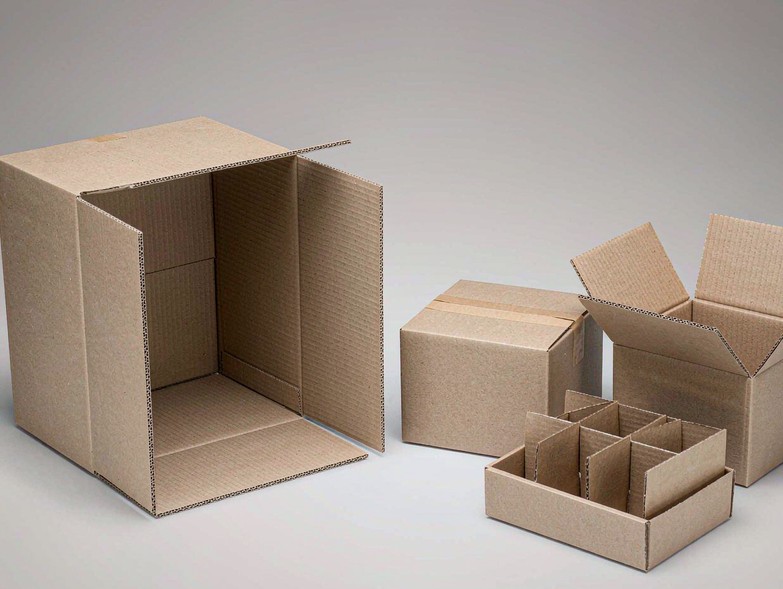
- Cargo Moisture Content (MC): Your garments must be thoroughly dried before packing. Textiles should ideally have an MC of ≤8%. Crucially, your packaging supplier must also control the moisture content of the paperboard: corrugated packaging boxes and rigid boxes alike should leave the factory at 10% or lower, with 12% as the absolute ceiling.
- Ambient Container Humidity: You must use desiccants to capture excess moisture from the air within the shipping container and within the individual garment boxes.
Board structure matters here too: a dense rigid box holds more moisture than a flat-packing folding carton, so whichever you specify, desiccant protocols and dry storage apply. Our comparison on rigid vs folding carton for apparel details these trade-offs.
3. Desiccants: Types, Dosing, and the DMF-Free Rule
Tossing a random packet of silica gel into a master carton is not a strategy; it is a gamble. Desiccant dosing requires basic chemistry.
- Silica Gel: Adsorbs roughly 40% of its own weight in moisture onto its surface. Good for individual small boxes but insufficient for large master cartons.
- Clay (Montmorillonite): Adsorbs about 50% of its weight. Often used as an eco-friendly alternative for short transit times.
- Calcium Chloride: The heavy lifter for sea freight. It absorbs several times its own weight in moisture through a chemical reaction, not just surface capture. Because it turns into a liquid brine as it absorbs water, it must be housed in a specialized, leak-proof chamber packet.
Container Dosing Rules:
For the container itself (the macro-environment), hang calcium chloride poles. In our experience, a standard 20ft container requires 4-8 poles and a 40ft High Cube (HC) requires 8-12 — and route length changes the dose: a 30-day passage can sit at the lower end, while 45 days or more calls for the top of the range.
Carton Dosing Rules:
Dose by desiccant type and air volume, because the two common chemistries are not interchangeable:
- Calcium chloride: roughly 0.15–0.20 kg per m³ of air space. A 0.1 m³ master carton therefore takes 15–20 g.
- Silica gel: the classic empirical rule is 150–176 g per m³ of air space — adequate for small enclosed volumes, but no match for calcium chloride when the whole container is at stake.
The DMF-Free Mandate:
Dimethyl fumarate (DMF) is a powerful anti-mold agent that was commonly used in the past. It is highly toxic and strictly banned in the EU (and restricted elsewhere). You must explicitly mandate that all desiccants and anti-mold chips used in your packaging are DMF-free. Ensure your supplier understands this by including it in your apparel packaging manufacturer questions during your initial audit.
4. What Your Packaging Supplier Can Engineer Into the Box
A proactive packaging manufacturer doesn’t just sell paper; they engineer solutions. Here is what they can build into your custom boxes to fight moisture:
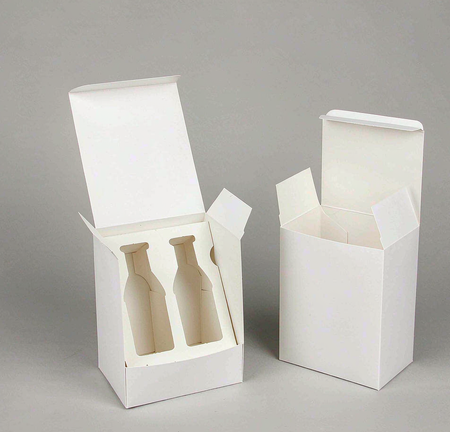
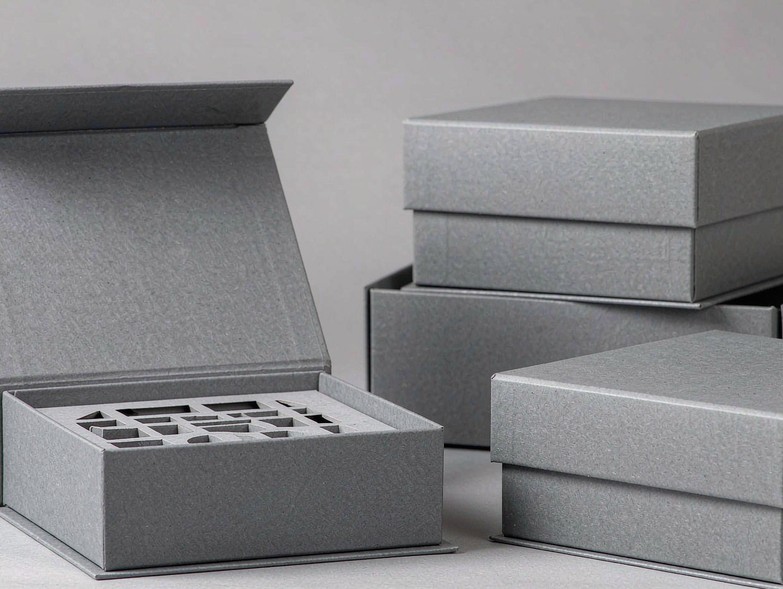
- Built-in Desiccant Slots: Instead of loose packets that might touch (and stain) a delicate garment, the factory can die-cut a specific slot or compartment in a rigid box insert to securely hold the desiccant. We discuss this level of engineering specifically in our custom shoe box manufacturer guide.
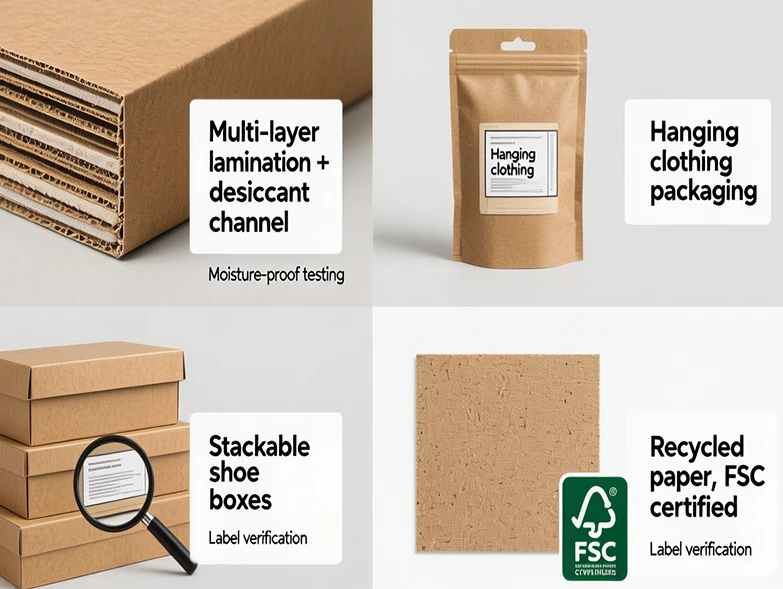
- Barrier Liners and Coatings: The factory can laminate a thin moisture-barrier film (like PET or PE) to the interior of the box, or apply a hydrophobic aqueous coating — ideally on FSC-certified board, whose chain of custody you can verify in the certificate database.
- H-Pattern Sealing: Specify that all master corrugated cartons must be sealed using the “H-pattern” method with moisture-resistant tape. This means taping the center seam and all four edge seams, drastically reducing air exchange.
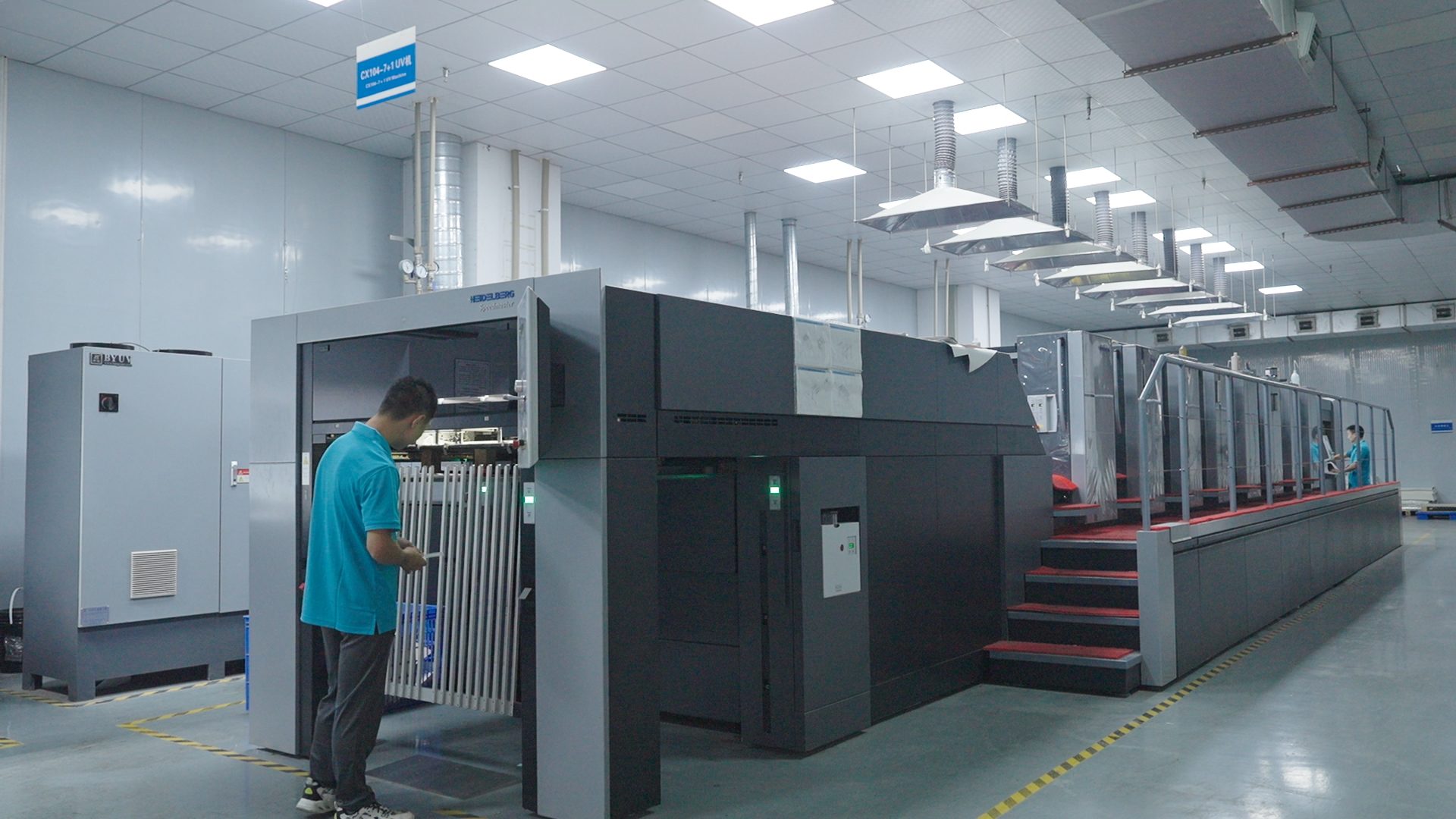
- Controlled Manufacturing Environment: A top-tier factory will store raw paperboard and finished boxes in a dehumidified warehouse so the cartons arrive at your garment factory at 10% or lower; the 12% ceiling is an arrival-inspection limit, not a production target. We run our own dehumidified storage this way — across 25 years of custom paper packaging production on an ISO 9001-certified floor, it remains one of the cheapest controls in the system.
5. Moisture-Barrier Layers by Route
Paper has physical limits — kraft packaging boxes are inherently hygroscopic (water-absorbing). If you are shipping on extreme routes, you must rely on plastic or foil barriers.
- Short Hop (e.g., Intra-Asia or short overland): A standard polybag (PE film) with a thickness of ≥80 um (microns) and a Water Vapor Transmission Rate (WVTR) of <5 g/m²/24h, measured per ASTM E96 at 38°C and 90% RH, is usually sufficient inside the master carton.
- Trans-Pacific / Tropical Routes (e.g., Asia to US East Coast via Panama Canal): The humidity risk is severe. Consider vacuum-sealing the clothing inside a heavy-duty foil-laminated bag within the master carton, alongside high-capacity calcium chloride desiccants.
- Extreme Conditions: In extreme cases where corrugated board will fail regardless of desiccants, consider switching to PP (polypropylene) corrugated plastic boxes for the master shippers, though this changes your cost structure — our apparel packaging cost breakdown walks through the trade-offs.
If you are striving for a plastic-free supply chain, you must accept higher risks on long sea routes or invest heavily in container-level dehumidification. Discuss these trade-offs using our eco-friendly apparel packaging supplier checklist.
6. Brief Your Supplier to Prevent Mold in Sea Freight Clothing
To ensure your packaging supplier and garment factory are aligned, copy and paste this specification template into your next RFQ or purchase order. You can integrate this directly into your master OEM/ODM apparel packaging brief.
MOISTURE PREVENTION SPECIFICATION:
- Carton Moisture Content (MC): All corrugated master cartons and rigid retail boxes must be delivered to the garment packing facility at a target moisture content of ≤10%, with 12% as the rejection ceiling.
- Desiccant Specification:
- Master Cartons: Insert 15-20 g of calcium chloride desiccant per master carton (0.15–0.20 kg per m³ of air space; a typical 0.1 m³ master carton takes 15–20 g).
- Retail Boxes: Insert silica gel or clay sized at 150–176 g per m³ of the box’s air space — typically 3-5 g for a standard apparel retail box.
- ALL desiccants and anti-mold chips must be certified 100% DMF-Free (Dimethyl Fumarate Free).
- Internal Barrier: Clothing must be sealed within a PE polybag (thickness ≥80 um, WVTR <5 g/m²/24h per ASTM E96 at 38°C / 90% RH) before placement in the retail box.
- Master Carton Sealing: All master cartons must be sealed using moisture-resistant packing tape applied in an H-pattern (center seam + 4 edge seams).
- Humidity Monitoring: One Humidity Indicator Card (measuring 5% to 60% RH) must be placed visibly at the top of one master carton per pallet.
7. Incoming QC on Arrival
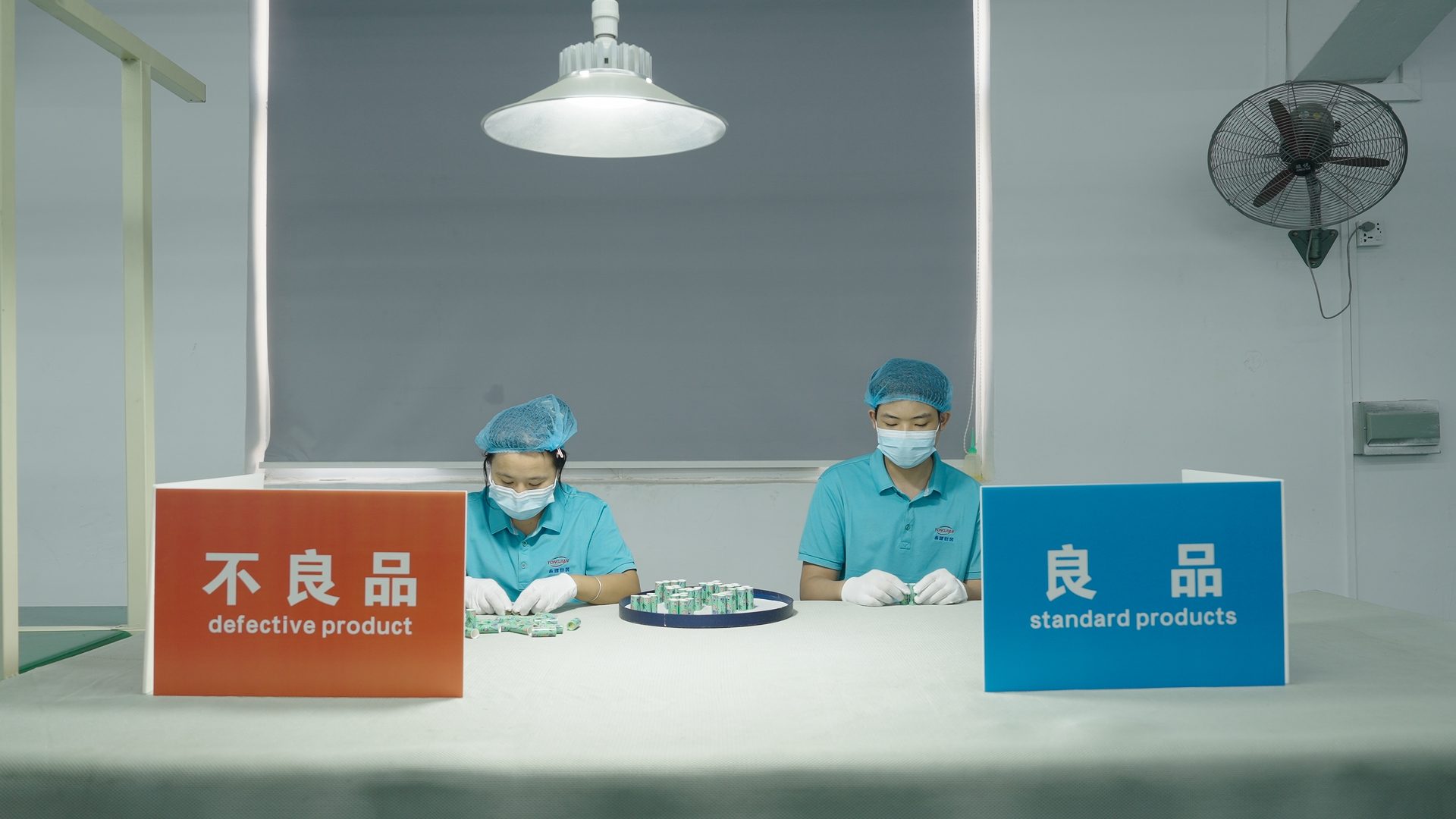
Your moisture-prevention strategy is useless if the factory ignores the brief. When your shipment arrives, your incoming Quality Control (QC) team must verify compliance before the goods enter the main warehouse. Sample per ISO 2859-1 General Inspection Level II, with the sample size drawn from your order quantity, and judge against AQL 2.5 for major defects and AQL 4.0 for minor ones — wet board, musty odor and visible mold are major findings, not cosmetic issues.
- Use a Moisture Meter: Test the corrugated master cartons immediately upon opening the container. Flag anything above 12% for intensive inspection; 10% or lower is the target.
- Check the Humidity Card: Locate the Humidity Indicator Card (if specified). If the indicated humidity has changed color according to the card’s reference scale — cobalt cards typically run blue to pink and cobalt-free cards orange to green, so the direction depends on the card type — the internal environment was compromised, and the garments must be inspected for visible mold growth and musty odor.
- Verify Desiccant Placement: Open several retail boxes to confirm the correct desiccant type and gram weight are present and securely placed in their designated slots.
- Require Photo Evidence: Mandate that the garment factory takes photos during the stuffing of the container, specifically showing the calcium chloride hanging poles properly installed.
If You Find Mold on Arrival:
Isolate the affected cartons and pallets immediately — do not release suspect stock into the warehouse. Photograph the mold, the humidity card and the container’s internal condition before anything is moved; that evidence decides the claim. Then establish responsibility: mold concentrated in the lower tiers of the container with a clean humidity card points to transit damage (container rain), while damp board and a triggered card at the packing stage point to the factory. Claim through cargo insurance or a supplier chargeback accordingly, and hold the isolated stock until the claim is settled.
8. Cost of Mold vs. Cost of Prevention
Procurement teams often benchmark moisture control against zero spend. The honest comparison is prevention against loss, and the two are not close.
What Prevention Costs:
Prevention is a short list of inexpensive inputs: desiccant dosing at 0.15–0.20 kg per m³, an H-pattern seal with moisture-resistant tape, a PE polybag, dehumidified storage of board and finished boxes, and one humidity card per pallet. Nothing on that list is exotic, and none of it moves your unit cost meaningfully. On our side, the in-house drop, moisture and transit simulations we use to validate these specs — benchmarked against ISTA test procedures — are routine product development, not a special project.
What One Mold Event Costs:
A single mold-affected shipment can write off an entire container’s worth of retail value. The direct losses stack quickly: the clothing itself, the packaging, rework or re-packing labor, and air-freight replacements to keep retail shelves stocked. Then come the indirect costs — chargebacks from the brand or retailer, expedited freight at spot rates, and working capital tied up in stock you cannot sell. In our experience, buyers have spent more on one emergency air-freight top-up than they would have spent on desiccants for a year of shipments.
The Asymmetry:
Prevention spend is predictable, budgetable and small. Mold loss is lumpy, unbudgeted and large. When being wrong costs a full container of retail clothing and being right costs a few grams of desiccant per carton, moisture control is not an expense line — it is the cheapest insurance in your supply chain.
9. Conclusion
Mold damage during sea freight is not an inevitable act of nature; it is a failure of supply chain engineering. By understanding the dynamics of container rain, strictly controlling the moisture content of your custom retail packaging boxes, and providing your supplier with a precise desiccant and barrier specification, you can protect your garments across any ocean route.
Do not wait for a ruined shipment to audit your packaging strategy. If you need a packaging manufacturer who understands the chemistry of global logistics, contact our engineering team. Request a moisture-proof packaging quote or send us your shipping routes and MOQ, and we will design a box that survives the journey.
FAQ
What is the difference between silica gel and calcium chloride?
Silica gel is suitable for small, enclosed spaces (like inside a shoe box) and adsorbs up to 40% of its weight. Calcium chloride is a heavy-duty desiccant used for shipping containers and large master cartons; it absorbs several times its weight and turns into a liquid, requiring specialized leak-proof packaging.
Why did my boxes collapse in the shipping container?
Corrugated board absorbs moisture from the humid air inside the container. As its moisture content rises above the 12% ceiling, the paper fibers weaken, drastically reducing the box’s Edge Crush Test (ECT) rating. When the bottom boxes can no longer support the weight above them, the pallet collapses.
Can I use anti-mold stickers instead of desiccants?
Anti-mold stickers (often releasing essential oils or safe chemical compounds) inhibit mold growth on the product itself but do not remove moisture from the air. They are a good secondary defense, but they must be used in conjunction with desiccants to address the root cause: high humidity.
What does “DMF-Free” mean and why is it important?
Dimethyl fumarate (DMF) is a chemical compound previously used to kill mold. It is a severe allergen that causes severe skin burns and respiratory issues. It is strictly banned in the EU and heavily restricted elsewhere. Always demand written proof that your packaging components are DMF-Free.
How do I check if my supplier dried the paperboard properly?
You can use a digital moisture meter with prongs designed for paper. Upon receiving a sample or a production batch, press the prongs into the corrugated board. A reading of 10% or lower indicates properly dried material; anything above the 12% ceiling should be rejected.