To an untrained eye, apparel packaging cost looks like a black box. You submit a design, and a factory returns a flat unit price of $2.50. But apparel packaging quotes bundle six distinct cost layers. A procurement manager who understands how to dissect these layers—separating substrate costs from tooling and ocean freight—can often engineer a 15% to 40% reduction in total landed cost without sacrificing retail quality.
This guide pulls back the curtain on factory pricing. We will break down exactly what drives your quote and provide a framework to negotiate from a position of technical strength. This is an advanced module expanding on the foundational principles covered in our master Apparel Packaging Guide.
Table of Contents
- The Six Layers of Apparel Packaging Cost
- Board & Substrate: Why Grade Sets the Floor
- Printing & Tooling: The Fixed Costs Behind MOQ
- Surface Finish & Add-Ons
- Landed Cost, Not FOB: Duties, Freight & Volumetric Weight
- Volume Discounts & MOQ Reality
- A Buyer’s RFQ Checklist to Get an Apples-to-Apples Quote
- Conclusion
1. The Six Layers of Apparel Packaging Cost
When a factory calculates your unit price, they are amortizing the following six components:

- Board/Substrate: The raw paper material (greyboard, corrugated, SBS). This typically accounts for 30% to 50% of the factory unit cost.
- Printing: Ink coverage, number of colors (CMYK vs. spot Pantone), and press time.
- Surface Finish: Post-press processes like lamination, spot UV, or foil stamping.
- Die & Tooling (Fixed Cost): The physical cutting molds and printing plates needed to manufacture your specific dimensions.
- Labor & Overhead: Machine setup time, hand-assembly (high for rigid boxes), glue, and factory margin.
- Freight & Duties (Landed Cost): The cost to move the box from the factory floor in Asia to your warehouse in the US or EU, plus customs tariffs.
If a supplier refuses to explain how these layers stack up in your quote, it is a red flag. You should immediately reference our list of apparel packaging manufacturer questions to audit their transparency.
Worked Example: Dissecting the $2.50 Box
Remember that flat $2.50 quote? This custom box cost breakdown shows how a folding carton at that price point decomposes across the six layers, using the ranges we see across the runs we quote each month:
| Cost layer | Share of $2.50 | Amount |
|---|---|---|
| Paperboard substrate | ~34% | $0.85 |
| Printing | ~18% | $0.45 |
| Surface finishing | ~12% | $0.30 |
| Tooling amortization | ~4% | $0.10 |
| Labour & factory overhead | ~22% | $0.55 |
| Inbound freight & handling | ~10% | $0.25 |
| Total | 100% | $2.50 |
Each layer answers to a different driver, and the driver determines what you can negotiate:
- Paperboard substrate (~$0.85): Driven by gsm and caliper. This is the floor of the quote — you can trade 400gsm SBS down to 300gsm, but you cannot negotiate a rigid-grade board down to a folding-carton price.
- Printing (~$0.45): Driven by color count and ink coverage. Dropping from six colors to four, or moving spot Pantone back to CMYK, trims this layer without touching the structure.
- Surface finishing (~$0.30): Driven by the finish menu. Aqueous coating is the cheapest line; foil and soft-touch are the most expensive. This is the most commonly over-specified layer.
- Tooling amortization (~$0.10): Driven by order quantity, not by negotiation. At 5,000+ units it nearly disappears; at 250 units it dominates the quote.
- Labour & factory overhead (~$0.55): Driven by assembly complexity. Auto-lock bottoms and flat-packed designs cut hand-work; rigid setup boxes cannot.
- Inbound freight & handling (~$0.25): Driven by CBM and pallet geometry. Flat-pack everything you can, and ship rigid boxes collapsible wherever the structure allows.
What can be cut: finishing scope, color count, and freight volume. What cannot be cut: substrate grade at your chosen structure, and tooling at low volumes. All figures are indicative factory-gate ranges as of 2026 and assume standard specifications; confirm with a formal quotation.
2. Board & Substrate: Why Grade Sets the Floor
The material you select dictates the absolute floor of your unit cost — which is why corrugated packaging boxes and rigid setups occupy such different price bands. You cannot negotiate a premium rigid box down to the price of a folding carton because the raw material cost is fundamentally different.
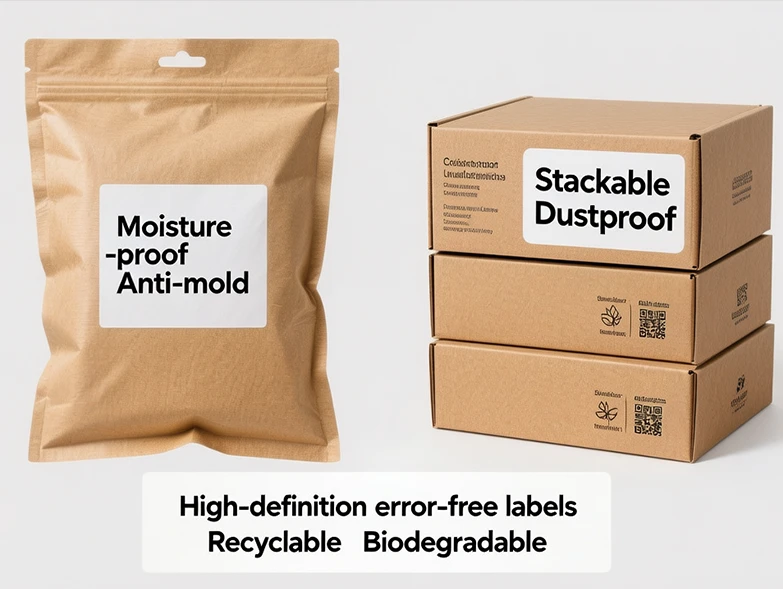
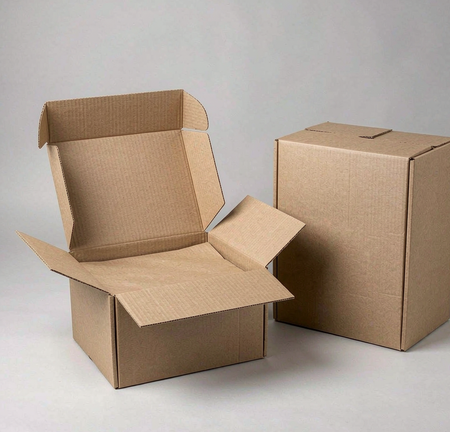
- Kraft Paper / Basic Corrugated: The most economical option. Unbleached kraft is cheaper than bleached white paper, which makes kraft packaging boxes ideal for standard DTC mailers and shelf-ready shippers.
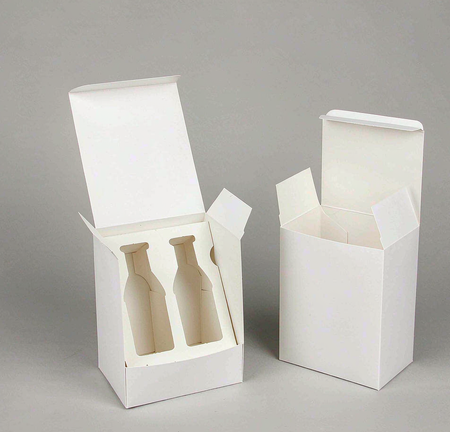
- White SBS (Solid Bleached Sulfate): A mid-tier, premium paperboard used for retail folding cartons. Costs scale predictably with the caliper (thickness) from 250gsm to 400gsm.
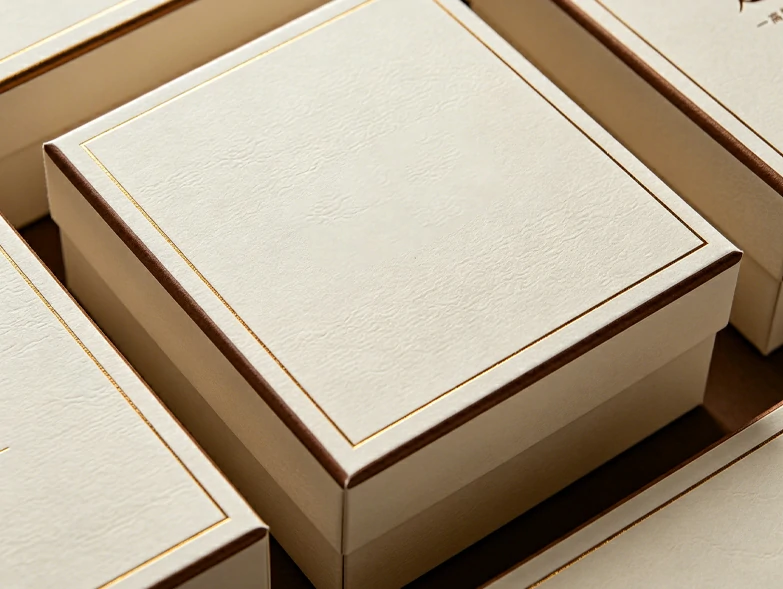
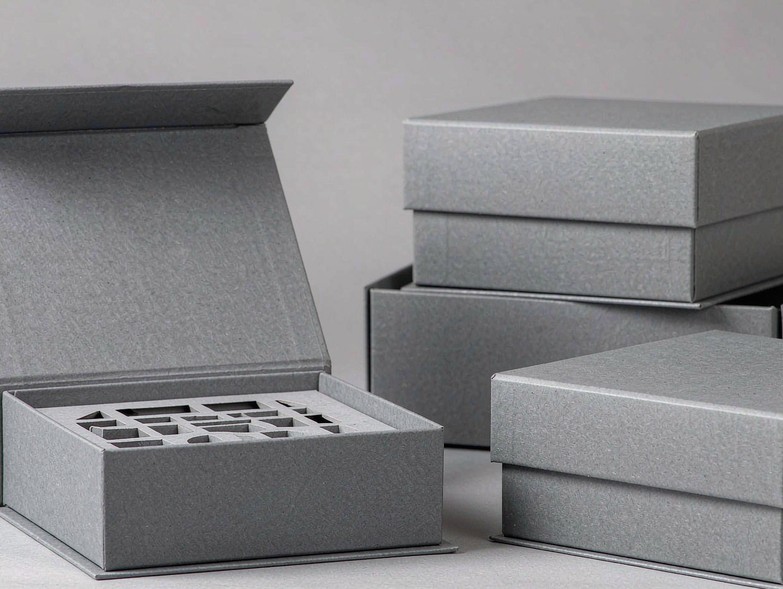
- Rigid Greyboard (1200gsm – 1800gsm): The most expensive substrate base. Because it requires a thick chipboard core and a separate printed wrapping paper, the material cost alone runs about 2x to 3x higher than a folding carton — and the finished unit price is often 3x to 5x higher once hand-assembly labor is added.
If your budget is tight, do not immediately demand a cheaper factory; instead, reassess your structural choice. Read our detailed comparison of rigid vs folding carton for apparel to see if you can achieve your brand goals with a lower-cost substrate.
3. Printing & Tooling: The Fixed Costs Behind MOQ
Understanding tooling is the key to better pricing. Tooling consists of the physical metal dies used to cut the paper and the printing plates used to transfer ink.

Tooling is a fixed cost. Across the runs we quote each month, a custom die mold and plate set typically costs between $150 and $600 to produce, regardless of whether you order 100 boxes or 10,000.
- The Short Run Trap: If you order a 250-piece pilot run and the tooling costs $300, you are paying $1.20 in tooling per box before a single sheet of paper is printed.
- The Amortization Advantage: If you order 5,000 units, that same $300 tooling cost is amortized down to just $0.06 per box.
This amortization curve is why factories enforce a Minimum Order Quantity (MOQ). It is also why you should insist that your supplier waives tooling fees on exact reorders, as the physical die has already been paid for.
4. Surface Finish & Add-Ons
Post-press finishing transforms standard paperboard into luxury packaging, but every process adds a distinct cost layer.

| Finish Type | Cost Impact | Visual/Tactile Result | Best ROI |
|---|---|---|---|
| Aqueous Coating | Very Low | Basic scuff protection, matte or gloss. | Standard retail cartons, high recyclability. |
| Lamination (Film) | Low-Medium | Deep matte or high gloss, highly durable. | Dark solid colors (prevents ink cracking on folds). |
| Spot UV | Medium | Raised, glossy highlight on specific areas. | Highlighting logos on matte backgrounds. |
| Hot Foil Stamping | High | Metallic or holographic reflection. | Premium rigid boxes; requires a custom heated brass die. |
| Soft-Touch Laminate | High | Velvety, premium tactile feel. | Luxury boutique apparel and footwear. |
Cost-Saving Tip: For custom retail packaging boxes, aqueous coating usually delivers the best cost-to-protection ratio. Instead of applying expensive foil stamping to the entire box, use a standard CMYK print for the design and apply foil only to a small, centralized logo. This reduces the size of the required brass die, lowering the tooling cost. If sustainability is a priority, be cautious: heavy laminations increase cost and decrease recyclability. Cross-check your finishes using our eco-friendly apparel packaging supplier checklist.
5. Landed Cost, Not FOB: Duties, Freight & Volumetric Weight
Your CFO cares about packaging landed cost, not the factory’s FOB (Free On Board) price. Landed cost includes the unit price, ocean/air freight, and import duties.

Incoterms Matter:
- EXW (Ex Works): The price of the box on the factory floor. You arrange and pay for all shipping.
- FOB: The factory pays to load the goods onto a ship at their local port.
- DDP (Delivered Duty Paid): The factory handles all freight, customs, and delivery to your warehouse door.
Volumetric Weight (The Shipping-Air Problem):
Ocean and air freight charge based on either actual weight or volumetric (dimensional) weight—whichever is greater. Rigid boxes ship fully assembled, meaning you pay to ship empty air. A rigid box that costs $2.00 FOB might cost an additional $1.00 in ocean freight. A flat-packed folding carton costing $0.50 FOB might only cost $0.05 to ship.
Duties (HS Code 4819):
Custom paper packaging generally falls under HS Code 4819. As of 2026, tariffs on Chinese paper packaging have swung widely, so treat any single percentage as stale within weeks: depending on current trade policies, import duties from Asia to the US have at times added up to 35% to the FOB price. Confirm the current HS 4819 rate with your customs broker, and always ask your freight forwarder for a duty estimate before finalizing your budget. If you ship into the EU, the Packaging and Packaging Waste Regulation (PPWR) and the European Commission’s packaging waste overview set the compliance backdrop for documentation and recycled content.
Right-Sizing:
Shaving just 10mm off the height of a custom shoe box might allow you to fit 5% to 15% more boxes onto a standard shipping pallet, depending on pallet geometry and layer rounding, slashing your per-unit freight cost. For a deeper look at footwear sizing strategies, consult our custom shoe box manufacturer guide.
6. Volume Discounts & MOQ Reality
Pricing curves in paper packaging are steep. Moving from an MOQ of 500 units to 3,000 units can trigger tier discounts of 25% to 50% on the factory unit price.
- High-Volume (Automated): Folding cartons and standard mailers require high-speed machine setup. Below 1,000 units, the setup time costs more than the paper. The price drops dramatically at 3,000 and 5,000 units.
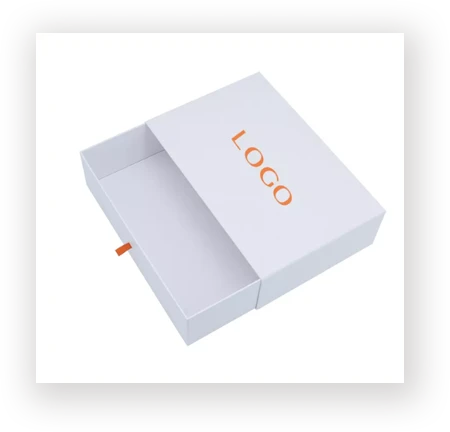
- Low-Volume (Manual): Rigid setup boxes require significant hand labor. You can often secure a 250-500 unit run, but the unit price will reflect the slow, manual assembly.
The Phased Order Strategy:
If your budget is tight but you anticipate growth, negotiate a “blanket order.” Agree to a 10,000-unit price, but ask the factory to produce and ship in two batches of 5,000, spacing out your cash flow while securing the high-volume discount tier.
What We Quote Ourselves:
As a consumer goods packaging manufacturer with 25 years of engineering expertise in custom paper packaging, we quote these tiers every week. Our ISO 9001 certified process holds the defect rate strictly under 0.5%, white samples leave our floor in 3 days, and bulk delivery runs 10–15 days. In our experience, apparel box pricing at these volumes is driven far more by substrate and assembly method than by negotiation skill.
What a Box Should Actually Cost
Before you benchmark a quote, anchor yourself to a reference range. As indicative factory-gate ranges as of 2026, assuming standard specifications:
- Folding cartons: $0.20–$0.80 per unit
- Rigid boxes: $2.50–$8.00 per unit
- Corrugated shoe boxes: $0.35–$0.90 per unit; rigid premium shoe boxes: $1.80–$4.50 per unit
- Dies and tooling: $150–$600; PPS proofs: $100–$300
A quote far below these bands usually signals a substituted substrate or an outsourced run; a quote far above them usually signals over-specified finishing. For footwear-specific detail, see our custom shoe box manufacturer guide. All figures are indicative factory-gate ranges as of 2026 and assume standard specifications; confirm with a formal quotation.
7. A Buyer’s RFQ Checklist to Get an Apples-to-Apples Quote
To stop factories from hiding fees or substituting cheaper materials, your Request for Quotation (RFQ) must be exhaustive. Use our OEM/ODM apparel packaging brief template, and ensure it includes:
- Exact Structure: (e.g., “Two-piece rigid setup box”).
- Internal & External Dimensions: (L x W x H in millimeters).
- Substrate Spec: (e.g., “1200gsm greyboard wrapped in 157gsm C2S art paper”).
- Print & Finish: (e.g., “CMYK outside, unprinted inside, matte lamination, gold foil logo 5x5cm”).
- Volume Tiers: (Request pricing for 500, 1000, and 3000 units).
- Incoterm & Port: (e.g., “FOB Shenzhen” or “DDP Los Angeles”).
Demand a Broken-Down Quote:
Do not accept a flat “$2.50/unit.” Every custom apparel box quote should separate:
- Unit Price (at specific volume tiers).
- One-time Tooling/Die Fees (in our own quoting, $150–$600).
- Pre-Production Sample (PPS) Proofing Fees (in our own quoting, $100–$300, usually credited against the production order).
- Estimated CBM (Cubic Meters) for freight calculation.
8. Conclusion
An opaque packaging quote is a liability; a transparent, itemized quote is a tool for strategic cost reduction. By understanding the fixed costs of tooling, the material realities of your substrate, and the devastating impact volumetric weight has on your landed costs, you can right-size your packaging to hit your budget targets without cheapening your brand.
Are you preparing a budget for an upcoming apparel launch or looking to lower your current packaging spend? Do not settle for a black-box quote. Submit your structural requirements and volume tiers to our engineering team today, and we will provide a comprehensive, itemized quote designed to minimize your total landed cost.
FAQ
Why did my factory charge a “plate fee” on a reorder?
They shouldn’t, unless you changed the design. Printing plates and die-cutting molds are physical tools paid for during the first run. A reputable factory stores these tools for you. If you order the exact same box again, the tooling fees should be waived.
Is digital printing cheaper than offset printing for small orders?
Yes, for very small orders (under 250 units), digital printing is cheaper because it requires no printing plates (zero setup cost). However, the per-unit cost of digital ink is high. Once you pass ~500 units, traditional offset printing becomes significantly cheaper and offers better color matching (Pantone).
How much should a custom structural sample cost?
A structural “white dummy” (unprinted, machine-cut) is often provided for free or for a nominal courier fee. A fully printed, color-matched Pre-Production Sample (PPS) requires machine setup and typically costs between $100 and $300, which is usually deducted from your mass production invoice.
Does ink color affect the price?
Standard CMYK (full color) pricing is generally flat regardless of the design complexity. However, if your brand requires exact, proprietary colors, you must specify spot Pantone (PMS) inks. Each Pantone color requires a dedicated press station and custom ink mixing, which increases the setup cost.
Can I lower my freight cost without changing the box size?
Yes, by changing the box structure. If you are currently shipping assembled rigid boxes, ask your factory to re-engineer them as “collapsible rigid boxes.” They use magnetic closures to snap into a rigid shape at your warehouse but ship entirely flat, cutting your ocean freight volume by up to 70%.